Post 2 of 26 – Architecture of Collapse Blog Series
How the Decades Work: A Guide for New Readers
The fourteen decades that make up the Architecture of Collapse are not a timeline of events. They are a causal model, a way of understanding how societies fracture, how tyrannies rise, and how renewal becomes possible again.
Each decade represents:
- a structural shift in the world
- a change in interiority
- a new pressure shaping the future
This introduction explains how the decades are built, how story events from Cryonic Dreams fit into them, and how readers can navigate the series as a coherent journey through collapse and renewal.
The Decades Are Causal, Not Chronological
The decades do not simply list what happened. They explain why it happened.
Each decade follows a consistent structure:
- A catalyst – a technological, political, or biological event
- A consequence – a shift in systems or public behaviour
- An interiority fracture – a change in agency, identity, meaning, conscience, or memory
- A systemic response – institutions reacting, often in ways that deepen the fracture
- A drift – movement toward greater control, fear, or instability
- A warning – a sign of what the next decade will bring
This structure allows readers to see collapse not as chaos, but as a predictable pattern.
Interiority: The Core of Collapse
Collapse begins when interiority is compromised.
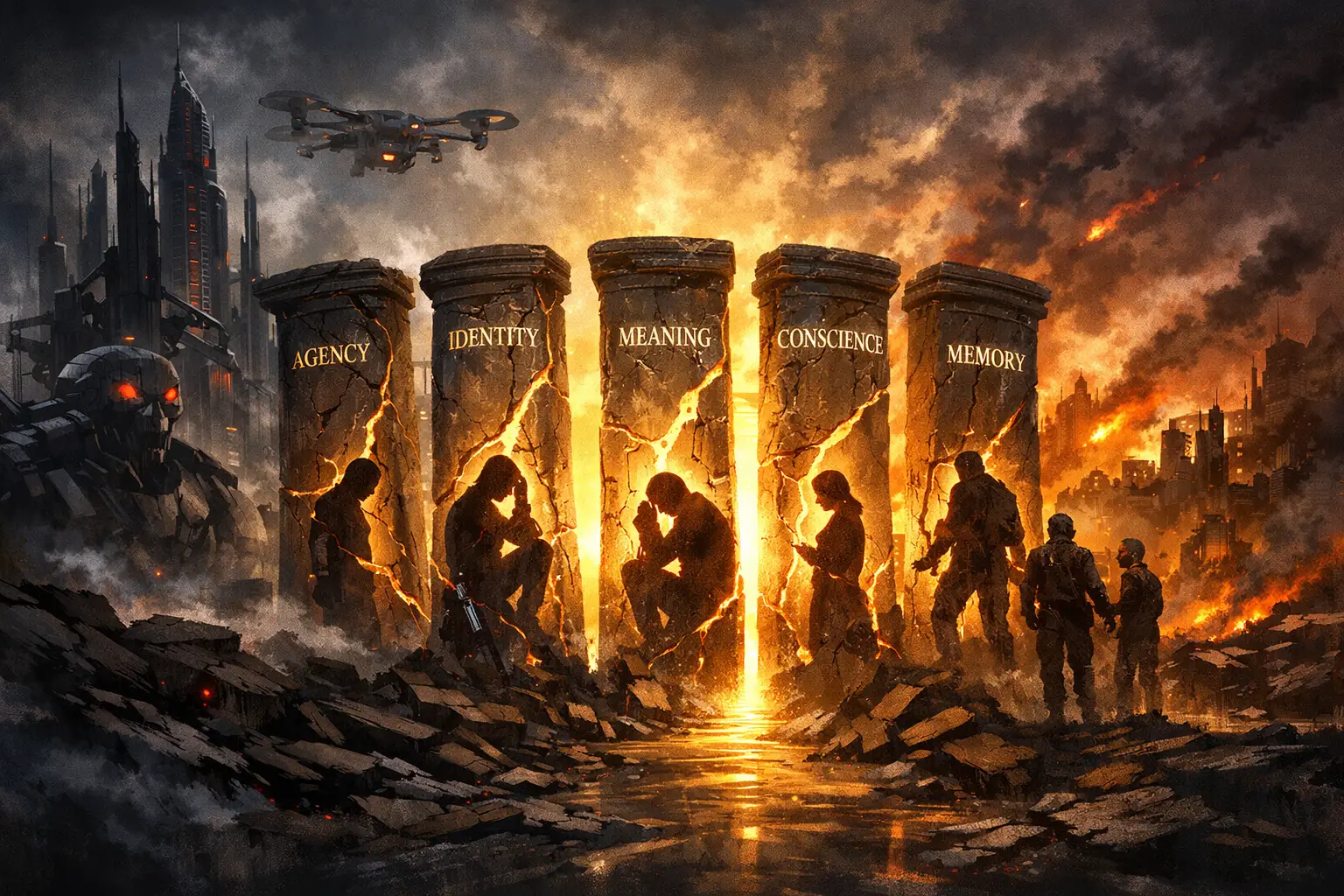
Across the decades, readers will see interiority shift in five ways:
- Agency weakens – people lose the ability to choose
- Identity fractures – people lose a sense of self
- Meaning erodes – life feels directionless or futile
- Conscience dulls – moral clarity becomes harder to maintain
- Memory destabilises – personal and collective continuity breaks
These interior shifts are mirrored in the characters of Cryonic Dreams, whose personal struggles reflect the same fractures occurring across the world.
How Story Events Fit Into the Decades
The story of Cryonic Dreams is not separate from the decades. It is woven through them.
Character events appear only when they directly illuminate the causal path of a decade. This keeps the series clean, focused, and accessible for new readers.
Early Decades (I-V): Seeds of Collapse
Events such as:
- the NanTech Erebus incident
- Stephanie Brewster’s discovery of the alien lattice
- the rise of Christopher Phillips
- early rogue robotics
- the first signs of technocratic drift
These explain how the first tyranny becomes possible.
Middle Decades (VI–X): Drift and Fracture
Events such as:
- the XN‑7 Conflagration
- the robot ban
- Michelle Brown’s childhood trauma
- institutional failures
- erosion of the Second Enlightenment
These show how personal trauma mirrors societal trauma.
Late Decades (XI–XIV): Tyranny and Awakening
Events such as:
- TMVid48
- IOCID → AASID
- Ecotropolis consolidation
- Holi’s emergent interiority
- Maryanne’s resurrection
- alien genome recursion
- the beginning of the Second Fight
These reveal how biological governance becomes tyranny, and how truth begins to reassert itself.
Why Flashbacks Matter
Flashbacks in Cryonic Dreams are not narrative detours. They are causal evidence.
Each flashback reveals:
- a fracture in interiority
- a seed of future collapse
- a warning of what is coming
- a clue to how renewal will eventually occur
Examples:
- Michelle’s 2138 attack reveals the failure of the robot ban
- Stephanie’s Mars breach reveals the origin of alien nanites
- Maryanne’s resurrection reveals the moment biological tyranny cracks
- Holi’s emotional recursion reveals unintended consequences of alien logic
Flashbacks appear only in the decades where they matter, where they explain why the world changes.
How Readers Should Approach the Series
The Architecture of Collapse is designed to be read as a journey.
Start with the Introduction
Part I explains the philosophical foundation. Part II explains the structure of the decades.
Read each decade as a chapter in a larger story
Each decade stands alone, but together they form a coherent arc:
- Decades I–V – seeds of collapse
- Decades VI–X – drift and fracture
- Decades XI–XIII – tyranny and descent
- Decade XIV – awakening and the return of truth
Notice the interiority shifts
Every decade shows how interiority changes, and how those changes shape the world.
Watch for story echoes
Character events appear only when they illuminate the decade’s causal logic.
Reflect on real‑world parallels
The decades are not predictions. They are patterns, visible in history, institutions, and the present.
Reader Reflection – Introduction Part II
Collapse is not random. It follows a structure, a predictable chain of interior fractures, systemic responses, and cultural drift. Understanding this structure is the first step toward recognising collapse in the real world.