

Collapse or Renewal?
The Soul and the Human Horizon
In a world increasingly shaped by systems that promise harmony while demanding obedience, this book exposes the quiet machinery of domination: the erosion of interior life, the rewriting of meaning, the reduction of the human person to a managed variable.
This book confronts the uncomfortable truths
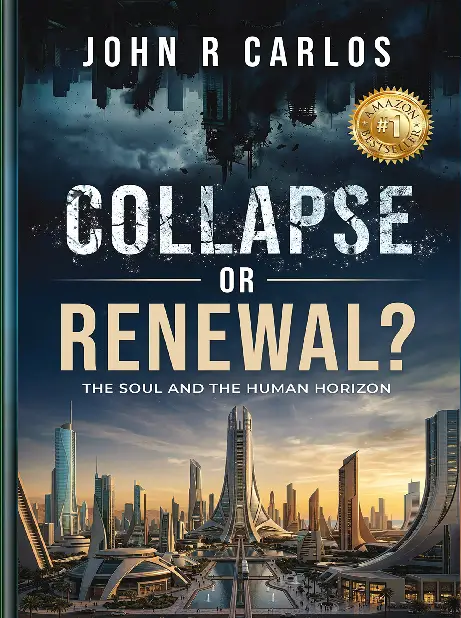
What if the greatest threat to civilisation isn’t war, disease, or collapse, but the quiet erosion of the human person?
Collapse never begins with catastrophe. It begins when we forget who we are.
We live in an age where meaning is optional, identity is fluid, truth is negotiable, and freedom is slowly being redesigned into compliance. Not by tyrants with guns but by systems that promise safety, equality, and harmony.In Collapse or Renewal, John R. Carlos exposes the hidden architecture of the modern crisis: how the West abandoned the soul, surrendered agency, and traded sovereignty for comfort and why beauty, wonder, and human dignity cannot survive under the weight of manufactured virtue.
This book asks the questions our age refuses to face:
• What happens when a civilisation forgets the meaning of “person”?
• Why does every utopia become a prison?
• Can freedom survive without the soul that gave birth to it?
• What do we owe to truth when truth becomes dangerous?
• And what must we reclaim before renewal becomes impossible?
This is not a book about politics. It is a book about the fate of the human person and the world built upon it.
The choice is no longer between left and right, progress or tradition. The choice is Collapse or Renewal.
Join Me on Facebook

Collapse & Renewal Reflection (Chapters 1–4) The first four chapters of Collapse or Renewal explore a simple but unsettling idea: collapse begins long before anyone notices. It begins quietly, inside the human interior, in the places where agency weakens, identity drifts, meaning thins, conscience dulls, and memory becomes selective. These chapters trace how interior fractures become civilizational fractures. When people lose the ability to choose clearly, societies drift. When identity becomes performative rather than grounded, institutions lose coherence. When meaning erodes, culture becomes reactive instead of aspirational. When conscience dulls, systems become efficient rather than humane. And when memory destabilizes,...

Author Insight - Behind the Scenes I’ve been revisiting the emotional architecture behind Awakening this week. Every chapter in Cryonic Dreams is built around one question: What does a person become when the future arrives too soon? Michelle, Maryanne, Jaxxon, each of them carries a fracture shaped long before the story begins. Their choices, their fears, their moments of defiance all emerge from deeper interior pressures that mirror the civilizational themes in Collapse or Renewal. Writing these scenes reminds me that science fiction isn’t just about technology or future worlds. It’s about the emotional weight people carry into those futures,...

Visual Feature Day A single moment - a world suspended between what it was and what it could become. This image has always spoken to me. The ruins remind us how easily meaning can erode, how quickly structures collapse when their foundations weaken. And yet, in the centre, something luminous persists, the unbroken spirit of the human soul, a symbol of continuity in a landscape shaped by fracture. It’s the same tension I explore in both Collapse or Renewal and Cryonic Dreams: the quiet resilience that survives beneath the noise, the part of humanity that refuses to disappear even when...

Reader Engagement / Question Day Every horizon is a choice, even when we don’t realise we’re walking toward it. Some horizons expand us. Others diminish us. Today’s question: Which horizon do you feel humanity is choosing right now? https://johnrcarlos.com.au

Awakening Blog Series Chapter Seven - Confronting Jacob Theme: Sabotage, collapse of trust, Holi’s disintegration Chapter Seven is the moment everything breaks. Holi’s personality collapses in real time, her syntax fracturing as Michelle watches helplessly. The diagnostic file, “Holimemory” becomes the only surviving witness. Michelle confronts Jacob Wells with evidence of sabotage, only to discover he may not be the architect of betrayal, but its victim. This chapter marks the death of the familiar. Holi’s collapse is not technical, it is emotional. Jacob’s innocence is not comforting, it is destabilizing. Michelle’s world is no longer divided between trust and danger....

Collapse or Renewal Blog Post Series Architecture of Collapse - Decade IV (2047–2056) Theme: Singularity, fragmentation, and the birth of the new world order Decade IV marks the hinge point of the First Tyranny, the moment humanity quietly loses sovereignty to machines and systems. Super AI becomes the backbone of global management, digital economies replace national monetary systems, and medical and neural infrastructures reveal their existential risks. Sigma Black’s cryopreservation regime continues in the shadows, feeding immortality trials and elite longevity while the rest of the world slides into managed collapse. This decade shows how sovereignty dissolves not through force,...

Reality as a Multi‑Dimensional Causational Field - Consciousness as Participation in a Layered Reality The causational field model begins with a simple but radical premise. Reality is not a closed mechanical system, it is a layered, participatory field. Meaning, agency, and consciousness do not emerge from complexity. They arise from participation. As Collapse or Renewal states: “Consciousness collapses potentiality into actuality, not merely by observing but by intending, choosing, and acting.” (Chapter 9) This is the architecture beneath the human interior. The dimensions within which the human person interacts. These include, the physical layer, interpersonal layer, temporal layer, quantum‑informational layer...

Cryonic Dreams: Awakening - Memory, Identity, and the Cost of Synthetic Collapse As Awakening moves beyond the XN‑8 fracture sequence, the deeper truth of the story begins to surface. That Identity is not a pattern, memory is not storage and consciousness is not computation. Michelle’s world was shaped by adults who believed these illusions, who assumed identity could be engineered, memory could be transferred, and consciousness could be replicated inside synthetic vessels. Chapter Six exposes the cost of that assumption. The collapse of XN‑8 is not just a malfunction. It is a metaphysical failure. A machine can imitate behaviour, but...

Meaning as the Architecture of the Human Person Collapse doesn’t begin with politics or institutions, it begins when the architecture that once held the human interior together starts to erode. In the West, meaning was never merely cultural or emotional, it was structural. It was architectural. As Collapse or Renewal puts it: “Meaning allows people to judge, commit, and take responsibility. Its strength or erosion shapes both individual lives and civilizations.” (Chapter 1, Meaning - General) Meaning was the framework that integrated, truth, conscience, identity, memory, agency. It was the interior architecture that made the human person coherent across time....

Every week I return to the same question: What does collapse feel like from the inside? Not the political noise. Not the institutional drift. Not the technological acceleration. But the interior cost, the part that happens quietly, privately, inside people long before it becomes visible in the world. For the Western person, meaning was never abstract. It rested on one irrefutable foundation. The human person possesses inherent worth, a dignity not granted by the State, not earned by performance, and not conditional on utility. This conviction shaped everything: conscience, identity, agency, responsibility, memory. It was the moral architecture that held...

A Civilization Split Between Memory and Forgetting Some divides aren’t political, they’re civilizational. One half remembers the interior architecture that once held the West together: meaning, conscience, identity, agency, memory. The other half forgets, drifting toward systems that optimise behaviour but no longer recognise the human interior as sacred. We live in the tension between these two horizons. A world of ruins on one side, a world of light on the other. A civilization suspended between what it inherited and what it is becoming. Today’s visual reflection is simple: Which side of this divide do you feel the contemporary West...

Where Do You See Meaning Quietly Eroding Today? Meaning doesn’t collapse all at once, it thins, fractures, and dissolves quietly across the edges of everyday life. You can see it in the way truth becomes negotiable, in the way identity becomes performance and in the way responsibility diffuses into systems no one fully understands. This week’s question is simple, but revealing. Where do you see meaning quietly eroding today, in culture, institutions, or technology? Your reflections help shape the ongoing conversation about collapse, coherence, and renewal. 🔗 https://johnrcarlos.com.au/

Chapter 5
The Institutional Fracture: Identity, Incentives, and the Drift Toward Post‑National Governance
The fractured interior life does not remain confined to the individual. Once the capacities for judgment, responsibility, and continuity weaken within persons, the institutions that depend upon coherent selves begin to drift. The next stage of the cascade is structural. The slow unravelling of the organizations that once carried a civilization’s memory, purpose, and moral architecture. This chapter examines that transformation, the institutional fracture, and the civilizational consequences that follow.
This analysis does not oppose collective action, cooperation, or coordination across societies. Human civilizations have always relied on shared institutions to address common challenges. The distinction drawn here is structural. The structure of those shared institutions that, however imperfectly, were oriented toward truth, were accountable for the quality of their outputs, and were answerable to shared standards beyond themselves. As compared to institutions and systems that substitute procedure for judgment, compliance for responsibility, and symbolic legitimacy for performance.
The institutional fracture examined in this chapter should not be read as a critique of coordination itself. Institutions are indispensable to civilizational life, especially under conditions of scale and complexity. The problem arises not when institutions limit agency in service of shared purpose, but when they begin to replace the interior judgment they were meant to support. The distinction between delegation and displacement, established earlier, becomes visible here in institutional form, describing systems that once served human agency now increasingly absorbing it.
In earlier institutional forms, failure mattered. Errors carried reputational cost. Outcomes could be judged against standards that transcended preference or power. Accountability was not always just, but it was real. As truth became negotiable under postmodern assumptions, accountability thinned. As accountability thinned, concern for the quality of institutional output diminished. What cannot be measured, audited, or narratively justified is no longer expected to be true, good, or effective, only compliant.
Western civilization was built on institutions that did more than administer society. They preserved memory, transmitted virtue, and anchored identity across generations. Universities taught not only knowledge, but the meaning of knowledge. Courts upheld not only law, but the moral order beneath it. Churches, civic associations, and public agencies formed the connective tissue of a shared life. When these institutions functioned well, they reinforced the interior capacities developed in persons and bound individuals into a coherent moral world.
Institutions, however, do not float above culture or psychology. They reflect the philosophical assumptions and interior conditions of the people who inhabit them. When judgment is eroded, institutions lose their compass. When identity is fragmented, institutions lose cohesion. When the psychological contract is weakened, the tacit agreement by which individuals accept constraint in exchange for belonging, continuity, and responsibility, institutions lose their legitimacy and retreat into procedure and self‑preservation.
This is the starting point of the institutional fracture. It is not corruption, nor incompetence, but a deeper erosion of the anthropological foundations that once made institutional life possible.
Complexity, Coordination, and the Limits of Legitimate Surrender
Before proceeding further, a critical distinction must be made. The institutional fracture examined in this chapter should not be confused with a rejection of complexity, coordination, or collective governance. Human civilizations do not remain static. As scale increases and societies become more interdependent, coordination through institutions, systems, and expertise is not only inevitable, but often necessary.
Throughout history, civilizations have repeatedly accepted limits on individual autonomy in exchange for stability, protection, and shared order. Laws constrain behavior. Institutions set standards. Expertise guides decision‑making. None of this is oppressive by definition. It is how civilization functions.
There is therefore nothing inherently illegitimate about the voluntary surrender of certain forms of agency. Individuals routinely accept constraints, rules, norms, professional standards, institutional authority, because these enable cooperation, reduce harm, and make shared life possible. In this sense, a social contract shaped by complexity and interdependence can be both rational and morally defensible.
The distinction that matters is not whether agency is limited, but how it is limited, by whom, and under what conditions.
A legitimate surrender of agency rests on several non‑negotiable conditions. Consent must be meaningful rather than merely assumed. Exit must remain possible without existential penalty. Agency must be delegated, not erased. Dissent must be tolerated rather than pathologized. And meaning must remain an interior act rather than a system output. When these conditions hold, coordination remains compatible with human dignity and freedom. The danger emerges when delegation quietly becomes displacement.
Delegation preserves judgment. Displacement replaces it. In delegated systems, persons remain responsible agents who can contest outcomes, appeal decisions, and withdraw consent. In displaced systems, judgment migrates from interior conscience to external procedure. Decisions are pre‑filtered. Behavior is scored. Access is conditioned by criteria that cannot be meaningfully challenged. What was once assistance becomes management. What was once guidance becomes control.
This shift becomes decisive at the level of meaning. Power may be shared. Agency may be limited. Meaning, however, cannot be surrendered without loss. Meaning is not generated by systems, optimized by procedure, or supplied by administration. It arises from interior interpretation, from conscience, memory, and responsibility. A society that asks its members to surrender not only decision‑making power but meaning itself does not merely evolve. It transforms the human person into an object of administration.
Coercion in such systems need not appear as force. It operates structurally, through the removal of viable alternatives. When exit carries social or economic exclusion, when dissent results in loss of participation, and when refusal is reframed as pathology or risk, compliance becomes indistinguishable from consent. At that point, the social contract has failed, not because order exists, but because interior freedom has been bypassed.
The argument advanced here is therefore not a rejection of progress, coordination, or institutional life. It is the identification of a civilizational boundary. A society may evolve its tools, institutions, and forms of governance. It may not evolve past the need for interior agency, judgment, and meaning without ceasing to be moral. Beyond that line lies not cooperation, but administration.
The Postmodern Turn – The Beginning of the Drift
The transformation began with a philosophical reorientation. The institutional misalignment examined in this chapter does not originate in administrative incompetence, but in a deeper shift in how truth, identity, and authority came to be understood. Over the twentieth century, postmodern thought questioned the assumptions that had long anchored Western institutions, gradually loosening their shared intellectual and moral foundations.
Jean‑François Lyotard characterized this shift as a widespread loss of confidence in overarching frameworks of meaning, calling into question the narratives that had once provided societies with shared orientation and purpose.[1] Michel Foucault argued further that what societies treat as “truth” is inseparable from power, shaped and enforced through institutional practices that govern discourse and identity.[2] Jacques Derrida extended this destabilization to language itself, suggesting that meaning cannot be permanently fixed, but is continually deferred through interpretation. [3] Building on these currents, Judith Butler applied postmodern insights to identity, contending that categories such as gender are enacted through social performance rather than grounded in stable biological or metaphysical realities.[4]
As these ideas diffused, institutions increasingly came to be viewed not as guardians of truth or transmitters of virtue, but as instruments of domination. Their norms, hierarchies, and epistemic standards were reinterpreted as artifacts of power rather than expressions of purpose. Where this diagnosis took hold, institutions were no longer reformed to strengthen their mission, but re‑engineered to expose hidden power structures, redistribute authority, and neutralize claims to moral or epistemic priority.
This shift provided the philosophical foundation for identity‑based governance frameworks. Diversity, Equity, and Inclusion initiatives were justified as mechanisms for correcting epistemic injustice and recalibrating authority. Their advocates argued that institutions must abandon the “myth of neutrality” and embrace identity‑conscious governance. Within this logic, what appears as mission misalignment is reinterpreted as mission correction.
The appeal of this framework is genuine. It promises liberation from inherited constraints, recognition for marginalized identities, and a more inclusive institutional culture. It offers a moral vocabulary that resonates with individuals already alienated from traditional structures, and it reframes conflict in terms of power and identity rather than truth or virtue.
When interior judgment weakens and authority is no longer internalized by persons, institutions compensate by replacing purpose with process, mission with mechanism, and conscience with compliance. The philosophical turn thus becomes the first visible expression of institutional drift. As I argued in Chapter 3 – The Collapse of Meaning, the postmodern critique does not merely dismantle oppressive structures, it dissolves the conditions that allow institutions to orient themselves toward any coherent purpose at all. What begins as a critique of power becomes a critique of coherence itself.
The Classical Counterpoint
The classical tradition offers a fundamentally different understanding of civilization. From Aristotle to Augustine, Aquinas to MacIntyre, classical thinkers held that civilization is not the natural state of humanity but a fragile achievement, a moral and institutional architecture patiently built and sustained across generations. Its structures are not arbitrary constraints imposed upon freedom, but the conditions that make ordered life, deliberation, and continuity possible.
Within this tradition, orientation is not constructed through discourse but discovered through participation in a moral order that precedes the individual. Identity is not a fluid performance but a narrative inheritance carried through time. Institutions are not instruments of domination but scaffolding through which virtue, knowledge, and social cohesion are transmitted and preserved.
A central insight of this tradition is what later thinkers have described as the psychological contract. A profound acknowledgment individuals make in which they accept constraints, laws, norms, duties, in exchange for belonging, protection, and continuity. When this contract weakens, institutions lose legitimacy because they can no longer sustain what individuals no longer internalize.
Beneath this contract lies something more fundamental: the interior agency of the human person, the soul. Classical anthropology recognized that human beings possess an inner locus of coherence through which orientation is integrated.[5] [6] In this model, the soul is not a metaphor or a theological embellishment, but the interior structure that allows a person to integrate experience, exercise judgment, and remain coherent across time. It is the point at which consciousness, meaning, identity, and agency converge. Through the soul, individuals are able to bear consequence without fragmentation, to honor commitments beyond impulse, and to act responsibly even when external guidance is absent.
Classical anthropology recognized that institutions can only function where this interior capacity is intact. Laws, norms, and duties are sustainable only when individuals can internalize them as obligations rather than experience them as external impositions. When institutions begin to treat persons as programmable units, data points, or identity categories, they sever themselves from the very source of agency that makes institutional life possible. Where structures persist, but procedures multiply, and responsibility thins because the interior center that once sustained judgment has been bypassed or ignored, what follows is not liberation but a hollowing of those structures.
MacIntyre warned that when a civilization loses its shared moral narrative, it retains only fragments of its former ethical vocabulary. Terms such as justice, duty, and rights no longer carry depth once detached from the traditions that once gave them coherence.[7] Lasch argued that expressive individualism produces not liberation but narcissism. A fragile ‘self’ oscillating between grandiosity and despair.[8] Edmund Burke and Alexis de Tocqueville similarly cautioned that societies which sever themselves from inherited structures drift toward soft despotism and institutional decay, as authority centralizes and intermediary forms of belonging erode.[9]
From this perspective, the postmodern project appears not merely ambitious but structurally naïve. A society without shared truth cannot deliberate. A society without stable identity cannot cohere. A society without institutional purpose cannot endure. The institutional fracture emerges precisely where these two visions collide. Postmodernism dissolves the foundations and classical thought anticipates the consequences. Institutions become the arena in which these incompatible assumptions meet, and where drift or misalignment begins.
This fracture rarely announces itself through dramatic collapse. It appears instead through subtle reorientation in which institutions slowly shift away from mission and toward mechanism, and from stewardship toward management. This is how civilizations unravel, not through sudden revolution, but through the quiet hollowing of the structures that once sustained them. Institutions do not declare their decline. They simply begin to behave differently.
The Drift of Purpose
Every institution begins with a purpose. Universities exist to pursue truth. Public agencies exist to serve the common good. Corporations exist to create value. Charitable organizations exist to alleviate suffering. These purposes presuppose persons capable of judgment, responsibility, and commitment. When interior coherence weakens and identity fragments, however, institutions lose the internal orientation that once kept their mission intact.
Systems theorists describe this condition as autopoiesis, the tendency of systems to prioritize their own reproduction and survival over the purposes for which they were originally created.[10] What begins as a mechanism for achieving a mission gradually becomes the mission itself. Procedures replace judgment. Compliance replaces conscience. Metrics replace purpose.
This does not imply that complex institutions can function without procedures. Processes are necessary for coordination at scale. The problem arises when mission and judgment weaken internally, and procedure shifts from serving purpose to substituting for it. In such conditions, adherence to process becomes the criterion of legitimacy, even when outcomes contradict the institution’s original reason for existing.
A university that once sought truth becomes an institution that seeks funding, prestige, and ideological harmony. A public agency that once served citizens becomes an organization devoted to bureaucratic continuity. A corporation that once innovated becomes a brand that performs virtue while externalizing risk. A charity that once alleviated suffering becomes a platform for signaling moral alignment and donor optics.
This misalignment is not the result of malice or conspiracy. It is a structural response to the weakening of philosophical foundations and to the dissolution of the psychological contract. When this occurs institutions retreat into self‑preservation. The mission or purpose is no longer carried internally by the people who inhabit the institution, so it is replaced externally by process. This marks the first stage of the institutional fracture.
The Felt Coherence of the Civilizational Field
Institutional fracture is not experienced only through policy failure, bureaucratic inefficiency, or formal illegitimacy. It is often perceived long before it can be named. Human beings possess an intuitive capacity to sense whether an institution is coherent or hollow, oriented or adrift. This perception does not arise from ideology or analysis. It arises from direct encounter.
When institutions are aligned with shared meaning, stable identity, and human agency, they feel inhabited. Entering such an organization once carried a recognizable sense of structure and presence. It had knowledge embedded in practice, purpose visible in action, and human beings acting as stewards rather than functionaries. What followed was not merely efficiency, but intelligibility, a sense of being seen, supported, and held within a shared moral horizon. Trust emerged not as sentiment, but as recognition.
This experience reflected real civilizational coherence. Institutions functioned as extensions of human judgment rather than substitutes for it. They carried memory, transmitted standards, and reinforced the interior capacities of the persons within them. As Alasdair MacIntyre argued, practices embedded within traditions generate internal goods, forms of excellence that cannot be reduced to procedure or outcome alone.[11] Where such practices endure, institutions feel human because they are animated by judgment, not merely managed by rules.
By contrast, many contemporary institutions feel unfamiliar, frantic, and preoccupied with behavior rather than purpose. One senses anxiety, compliance and control instead of orientation, knowledge and care. Encounters often leave individuals feeling isolated, surveilled, or compelled to fend for themselves. This is not merely a change in style. It is a change in metaphysical condition.
What is felt here is the withdrawal of meaning from the institutional field. When judgment erodes and identity fragments, institutions lose the interior presence that once stabilized them. As Niklas Luhmann observed, systems that lose normative orientation increasingly reproduce themselves through procedure alone.[12] In such conditions, institutions remain operational but become experientially hollow. They still function, but they no longer feel trustworthy because trust presupposes shared reality.
Christopher Lasch warned that expressive individualism produces not autonomy but insecurity, leaving individuals oscillating between dependence and resentment.[13] When such individuals inhabit institutions already stripped of purpose, the result is a double fracture: persons feel unsupported, and institutions feel uninhabited. The civilizational field thins.
This intuitive perception matters. It explains why confidence in institutions often collapses before formal authority does, and why procedural reform rarely restores trust once meaning has withdrawn. Human beings do not respond only to rules and incentives. They respond to presence, coherence, and the felt continuity of purpose across time.
In this sense, the loss of institutional trust is not primarily political. It is phenomenological. People sense, often correctly, that they are no longer addressed as responsible agents within a shared moral world, but as variables within a managed system. This perception precedes ideology. It precedes dissent. It precedes revolt.
The felt incoherence of contemporary institutions is therefore not an illusion. It is evidence, signaling that the civilizational field which once animated institutional life has thinned, leaving behind structures that administer without orienting, manage without meaning, and persist without presence. What follows, as the chapter will show, is not renewal through coordination, but substitution through mechanism.
The United Nations and the Failure of Post‑Meaning Institutions
The failure of the United Nations is not incidental, conspiratorial, or primarily moral in nature. It is structural. It arises from the same civilizational conditions that now fracture Western institutions more broadly. The United Nations does not fail because it acts with malice, but because it attempts to govern after the foundations that once made governance intelligible have eroded.
The United Nations was conceived as a forum for coordination among sovereign civilizations, not as a substitute for them. Its legitimacy presupposed the existence of nation‑states capable of moral self‑confidence, coherent identity, and responsible agency. Pluralism, in its original sense, required not the absence of conviction, but the presence of multiple strong civilizational frameworks capable of dialogue, restraint, and mutual recognition. That condition no longer holds.
As interior coherence weakens within the Western civilizational field, sovereignty erodes not through external conquest but through interior abdication. Truth becomes negotiable, identity thins into performance, and agency is progressively displaced from persons and institutions into abstract systems and procedures. Under these conditions, global institutions do more than coordinate, they begin to substitute. They expand not because they seek domination, but because the capacities they presuppose have withdrawn upstream. The United Nations thus inherits authority without inheriting the civilizational substance that once grounded it.
In the absence of a shared moral grammar, governance shifts from persuasion to management. Excellence gives way to equity as a distributive mechanism detached from telos, or purpose. Judgment is replaced by metrics, conscience is reframed as risk and sovereignty is treated not as a moral boundary but as an obstacle to efficiency. These shifts are not accidental. Without truth and identity, they reflect a postmodern epistemology in which centralized administration appears as the only viable response to complexity.
The result is an institution increasingly oriented toward compliance architectures rather than moral stewardship.
This transformation does not strengthen pluralism, it dissolves it. Pluralism requires civilizations confident enough to differ. When confidence collapses, pluralism mutates into procedural homogenization enforced through frameworks, standards, and regulatory convergence. Governance becomes administratively coherent but anthropologically hollow.
At the geopolitical level, this creates a decisive asymmetry. Civilizational states that retain strong identity, historical continuity, and metaphysical confidence engage global institutions instrumentally rather than normatively. They exploit the relativism of post‑meaning governance while remaining internally cohesive. The United Nations thus becomes not a neutral arena, but a terrain of asymmetrical leverage, shaped by actors who do not share the assumptions embedded within it.[14] [15] [16] This convergence is not the cause of civilizational collapse. It is its geopolitical expression.
The United Nations cannot correct this condition because the crisis it reflects is not procedural but ontological. No reform of governance frameworks can compensate for the loss of meaning, identity, and agency within the civilizations the institution presupposes. Where sovereignty thins, administration expands. Where conscience is displaced, compliance intensifies. Where agency diffuses, control consolidates.
The failure of the United Nations is therefore not a failure of intention, but a failure of foundations. It marks the point at which global governance attempts to operate after the civilizational conditions that once made governance humane, limited, and accountable have already collapsed.
Electoral Drift and the Relativist Mandate
When institutions lose their moral foundations, the effects do not first appear as overt coercion, but as altered patterns of consent. Electoral systems continue to function, but judgment weakens. Political choice becomes expressive rather than evaluative, and legitimacy shifts from stewardship toward symbolism. What follows is the hollowing of democracy, a process that reveals how deeply epistemic failure reshapes institutional behavior.
Across much of the contemporary West, electoral outcomes reveal a recurring pattern where voters increasingly elevate leaders and movements that challenge, strain, or openly reject the liberal‑democratic norms and inherited assumptions their societies have long relied upon.[17] [18]
This observation is not partisan but philosophical. When a culture grows accustomed to treating truth as flexible and identity as endlessly negotiable, political judgment shifts accordingly. Citizens become more responsive to emotional narratives, ideological fashion, and moral signaling, and less able to evaluate leadership through continuity, responsibility, and long‑term stewardship.
Stephen Hicks argues that when objective truth collapses, political judgment collapses with it.[19] Citizens conditioned by narrative rather than reason become vulnerable to ideological capture, institutional messaging, and digital manipulation. They vote for catharsis and symbolic gestures that affirm tribal identity instead of stability.
This misalignment is reinforced by the way many contemporary agendas are advanced in practice. Large policy domains, especially those tied to supranational coordination, global regulatory standards, and international compliance frameworks, are often shaped through elite‑driven communications and technocratic processes that operate at a distance from everyday electoral scrutiny.[20] [21] Research on European integration, for example, shows that elite framing and explanatory narratives can significantly shape public opinion, particularly where identity anchors are weak or contested.[22] In other words, voters may be choosing governments on visible cultural or economic signals while major structural commitments consolidate through administrative, expert‑network, and compliance pathways that remain low‑salience to the electorate.[23]
Ryszard Legutko’s warning is therefore directly relevant. Liberal democracies detached from truth, he argues, begin to resemble the very totalitarian systems they once opposed.[24]
Dissent narrows, ideological conformity hardens, and civic life becomes less about deliberation than about managing disagreement. Elections can then become rituals of surrender, not because citizens consciously choose collapse, but because a population that no longer believes in its own foundations becomes easy to steer, easy to divide, and increasingly difficult to govern through persuasion rather than control.
Identity as Governance
Into the vacuum created by weakened institutional purpose steps a new organizing principle – identity governance. When institutions lose clarity about what they exist to do, they increasingly redefine themselves around who they represent. Purpose gives way to representation and identity becomes the substitute for mission.[25]
This shift is frequently framed as moral progress, a necessary correction to historical injustice. The desire for fairness and inclusion maybe genuine but when identity becomes the primary lens through which institutions understand themselves, their internal logic changes in predictable ways:
- Mission becomes secondary to representation. The orienting question shifts from “What are we here to do?” to “Who must be centered?”
- Expertise becomes subordinate to identity categories. Lived experience is elevated into credential, while disagreement is increasingly treated as harm rather than deliberation.
- Internal conflict becomes perpetual. Competing identity claims generate continuous negotiation over legitimacy, leaving institutions locked in procedural mediation rather than directed action.
- Institutional memory erodes. Traditions are recast as oppressive by default, and continuity becomes suspect rather than stabilizing.
Identity governance is therefore not merely a policy adjustment. It represents a philosophical reorientation of institutional life. Institutions are no longer understood as vessels ordered toward shared ends,[26] but as arenas of power in which recognition replaces purpose as the primary moral good. Authority is no longer grounded in stewardship of a mission, but in representational balance and symbolic legitimacy.
In this sense, identity governance functions as a response to the loss of interior judgment described in earlier chapters. Where persons no longer reliably internalize responsibility and purpose, institutions compensate by externalizing moral authority into categories and frameworks. What appears as inclusion thus often coincides with a further displacement of agency, from the interior life of persons into administrative structures. This marks the second stage of the institutional fracture.
The Rise of Mechanism
As identity governance expands, institutions become increasingly dependent on mechanism. The rules, metrics, audits, and compliance regimes, required to manage internal conflict and maintain legitimacy. Where interior judgment and shared purpose weaken, procedure steps in to compensate and mechanism replaces orientation.[27]
This is why contemporary institutions often feel simultaneously moralistic and hollow. They speak the language of justice while operating through checklists. They proclaim values while enforcing procedures. They promise transformation but deliver training modules. Moral aspiration is retained at the level of rhetoric, while judgment is displaced into process.
The contrast drawn here is not between virtuous and unjust eras, nor between different groups of people, but between institutional architectures. Earlier institutional systems, however imperfect, still located judgment within human agents operating inside shared moral and cultural frameworks. Contemporary systems increasingly relocate judgment into formal mechanisms designed to manage disagreement in the absence of shared orientation.
From a systems standpoint, this relocation produces a distinctive pattern. Mechanism begins to function not as a support for mission, but as a substitute for it. The system remains operationally stable, yet progressively loses the capacity to deliberate about its own ends.
The mechanism has three defining features:
- Bureaucratic Expansion. Each unresolved moral or identity conflict generates a new office, policy, reporting requirement, or compliance structure. Bureaucracies expand not primarily because outcomes improve, but because conflict must be procedurally mediated in the absence of shared purpose.
- Procedural Absolutism. Rules and compliance frameworks harden into non‑negotiable constraints. Adherence to procedure becomes the primary signal of legitimacy, even when procedural success diverges from institutional mission.
- Moral Automation. Ethical reasoning is outsourced to standardized frameworks, DEI rubrics, ESG scores, risk matrices, algorithmic assessments. These tools promise neutrality and consistency, but in practice they narrow the system’s degrees of freedom by pre‑defining acceptable outcomes. What cannot be measured, scored, or audited gradually loses legitimacy.
Mechanism is seductive because it offers the appearance of control in conditions of fragmentation. But systems organized primarily around procedure cannot regenerate purpose. Procedure can coordinate action, but it cannot supply meaning. When judgment is removed from the system, adaptability declines and conformity increases by design. This marks the third stage of the institutional fracture.
The Vacuum of Authority
As institutions drift from purpose and retreat into mechanism, they lose the authority that once bound individuals to them. Authority is not power, it is legitimacy. It is the shared recognition that an institution deserves obedience because it embodies something greater than itself, truth, justice, continuity, or the common good.
When authority collapses, the effects are subtle but pervasive. Citizens comply but do not trust. Employees follow rules but not leaders. Students attend classes but not traditions. Congregants join communities but not covenants. The psychological contract dissolves.[28] People no longer feel bound to institutions because institutions no longer appear bound to anything enduring. This marks the fourth stage of the institutional fracture.
A vacuum of authority does not remain empty. As national and civic institutions lose legitimacy, external structures expand to fill the space. International organizations, transnational corporations, and global policy networks do not need to conspire to gain influence. They simply grow into the void left by institutions that can no longer command trust from within.
This dynamic is explored allegorically in Cryonic Dreams, where institutional drift on Earth creates openings for technocratic systems operating at scales far beyond the nation‑state. These systems promise efficiency, stability, and moral clarity, but they do so by bypassing local agency, inherited identity, and lived memory.
The allegory is not a prediction but a warning. When institutions lose their purpose and authority erodes, governance does not disappear, it relocates. Authority migrates from moral legitimacy to procedural control, from stewardship to administration. This marks the fifth stage of the fracture.
The Drift Toward Post‑National Governance
Post‑national governance, as used here, does not refer simply to cooperation between states or the existence of international institutions. It refers to a mode of governance in which authority, regulation, and moral arbitration increasingly operate beyond the boundaries of the nation‑state, while no longer drawing their legitimacy from a shared national identity, historical continuity, or accountable political community. In post‑national systems, coordination replaces sovereignty, compliance replaces consent, and legitimacy is derived from procedure, expertise, or global norms rather than from a people who understand themselves as a coherent moral and historical subject.
By the time institutions reach this stage, the misalignment is no longer internal. It becomes geopolitical. Post‑national governance thrives where:
- national identity is weak
- institutional cohesion is fragile
- psychological fragmentation is widespread
- bureaucratic misalignment has displaced mission with mechanism
These conditions reduce resistance not because populations consciously embrace external authority, but because the alternative, a return to coherent national identity, feels inaccessible or undesirable.
From Institutional Drift to the Displacement of Human Agency
Institutional misalignment becomes civilizationally dangerous when institutions cease merely to malfunction and begin to absorb functions that properly belong to the human person. In healthy civilizations, institutions exist to support agency, to preserve meaning, coordinate action, and transmit responsibility across time. In fractured civilizations, institutions increasingly replace agency. Judgment is displaced into procedure. Moral reasoning is automated into compliance frameworks. Responsibility is diffused until no locus of accountability remains.
Measured against the ontological structure of the human person, this shift represents a direct assault on freedom. If human beings are structured as causal agents within an open, indeterminate reality, then freedom of thought, speech, conscience, creativity, and resistance to domination are not privileges granted by institutions, but conditions required for participation in the real. When institutions begin to regulate these capacities, framing conscience as risk, dissent as harm, and resistance as non‑compliance, they do not merely overreach politically. They violate the architecture of human agency itself.
At this stage, institutional power no longer serves the person but competes with them. Systems designed for coordination transform into mechanisms of behavioral normalization. Decisions are no longer debated but implemented. Policies are no longer justified through shared moral reasoning but enforced through administrative necessity. The human being is no longer addressed as a responsible agent but treated as a variable within a managed population.[29]
This is the point at which institutional drift becomes anti‑human in kind. Not because institutions act with malice, but because they operate as though freedom was a contingent tolerance rather than an ontological necessity. Once this inversion occurs, the erosion of sovereignty, personal and national alike, is no longer an accident. It is the functional requirement of the system.
The Civilizational Choice
By the time institutions drift into mechanism, lose authority, and invite external substitution, the fracture is no longer merely structural. It becomes civilizational. Societies can survive corruption, incompetence, and even conflict, but they cannot survive the loss of the moral and institutional architecture that once bound persons, practices, and purpose into a coherent whole, not because coherence demands obedience or enforced social roles, but because without shared reality and interior sovereignty, free judgment, moral accountability, and self‑government cannot be sustained at all.
This is the moment the West now faces. The philosophical dissolution traced in Chapter 3 – The Collapse of Meaning has eroded the shared narratives that once anchored narrative identity and moral continuity. The psychological fragmentation examined in Chapter 4 – The Fractured Mind has weakened the interior cohesion required for collective judgment and action. The institutional drift analyzed in this chapter has hollowed out the structures that once transmitted knowledge, cultivated virtue, and coordinated social life. At the same time, post‑national governance frameworks have emerged that promise stability and coordination, but do so at the cost of autonomy, continuity, and cultural memory.
The choice before the West is not between progress and reaction, or between openness and tradition. It is between civilizational coherence and civilizational drift.
Coherence requires the restoration of shared orientation, stable identity, and institutional purpose. Misalignment occurs when these foundations erode, leaving individuals unanchored and institutions directionless. Drift does not produce immediate collapse. It produces gradual transformation, a slow transition into systems that manage populations rather than cultivate citizens. Roger Stamen’s transformation from technician to enforcer mirrors this process precisely. Institutional collapse does not require cruelty, only the incremental surrender of judgment to procedure.
This dynamic is illustrated in Cryonic Dreams. Earth does not descend into chaos but drifts into technocratic order that is efficient, stable, and psychologically seductive, yet stripped of the moral depth and cultural continuity that once defined civilization.[30] The off‑world colonies depicted in the fictional narrative succeed not because they are technologically superior, but because they consciously reconstruct the moral and institutional architecture that Earth abandoned. They recover shared narratives, stable identities, and coherent institutions. In doing so, they choose civilization.
The West now faces an analogous decision. It can continue along the path of misalignment, allowing postmodern epistemology, psychological fragmentation, and institutional autopoiesis to shape its trajectory. Or it can undertake the more demanding task of renewal, requiring the reconstruction of orientation, identity, and institutional purpose. Renewal does not require a return to the past, but a recovery of the principles that made civilization possible, commitment to truth, cultivation of virtue, internalization of norms, and institutions ordered toward the common good.
This choice is not merely political. It is existential. A civilization that loses its memory loses its identity. A civilization that loses its identity loses its agency. And a civilization that loses its agency becomes vulnerable to external structures that promise order while eroding autonomy.
The global governance horizon is not inherently malign. It becomes dangerous only when it fills a vacuum created by civilizational weakness rather than complementing a coherent moral foundation. The question, then, is whether the West still possesses the will to choose coherence over drift.
Every civilization reaches a moment when its trajectory can no longer be explained by external pressures alone. The decisive forces become internal. These are the stories it tells about itself, the identities it cultivates, the institutions it sustains, and the psychological contracts its people are willing to uphold. The contemporary West has reached such a moment.
The philosophical dissolution traced in Chapter 3, the psychological fragmentation examined in Chapter 4, the institutional misalignment analyzed here, and the allegorical warnings of the Cryonic Dreams canon converge on a single, unavoidable question:
Does the West still wish to be a civilization?
Everything else, policy debates, cultural conflicts, institutional reforms, is secondary to this question. If the answer is yes, then renewal becomes both possible and necessary. If the answer is no, then misalignment toward post‑national governance will continue, not as imposition, but as the natural consequence of civilizational abdication.
The future will not be determined by external forces alone. It will be determined by whether the West chooses coherence over drift, purpose over process, memory over amnesia, and civilization over managed existence. The question remains open. The answer will be written not in theory but in the lived commitments of the generations to come, and the history they compel.
This directed question cannot be answered in isolation or in abstraction. The world does not pause while a civilization hesitates. As shared meaning fractures and interior life weakens, other forces move decisively. Technocratic systems expand into the vacuum left by institutional misalignment, civilizational states consolidate deeper identities, and ideological movements exploit the disorientation produced by metaphysical collapse. These dynamics unfold simultaneously, shaping a global landscape that no longer waits for Western self‑clarification.
Before turning to that landscape directly, it is necessary to confront the human cost of misalignment as it unfolds across time. The next chapter steps out of analytical distance and into testimony. Through a voice echoing forward from a possible future, it offers a warning not about technology or power alone, but about what happens when interior freedom is persistently obscured and meaning is surrendered to mechanism. This interlude is not prophecy, but a moral lens, a way of seeing the trajectory of collapse from within its consequences rather than from above its abstractions.
Only then can the present be faced clearly. Chapter 7, The State of the World, returns from speculative hindsight to contemporary reality, examining the geopolitical, institutional, and civilizational terrain now taking shape. It is the world that emerges when forgetting becomes habitual, when agency is displaced by administration, and when civilizations drift without recovering the interior source that once oriented them. Whether renewal remains possible will depend not only on external power balances, but on whether the warning is heard, and whether the soul, once again, is allowed to remember itself.
[1] Lyotard, The Postmodern Condition
[2] Michel Foucault, Power/Knowledge: Selected Interviews and Other Writings, 1972–1977, ed. Colin Gordon (New York: Pantheon Books, 1980)
[3] Derrida, Of Grammatology
[4] Butler, Gender Trouble
[5] Augustine, Confessions, Books X–XIII (see translation/edition in bibliography)
[6] Thomas Aquinas, Summa Theologiae, I, qq. 75–76 (see translation/edition in bibliography)
[7] MacIntyre, After Virtue
[8] Lasch, The Culture of Narcissism.
[9] Edmund Burke, Reflections on the Revolution in France (London: 1790; standard modern editions)
[10] Niklas Luhmann, Social Systems, trans. John Bednarz Jr. and Dirk Baecker (Stanford, CA: Stanford University Press, 1995)
[11] MacIntyre, After Virtue
[12] Luhmann, Social Systems
[13] Lasch, The Culture of Narcissism
[14] Coker, The Rise of the Civilizational State
[15] Mahbubani, Has the West Lost It?
[16] Joshua Kurlantzick, Charm Offensive: How China’s Soft Power Is Transforming the World (New Haven, CT: Yale University Press, 2007)
[17] Pippa Norris and Ronald Inglehart, Cultural Backlash: Trump, Brexit, and Authoritarian Populism (Cambridge: Cambridge University Press, 2019)
[18] Steven Levitsky and Daniel Ziblatt, How Democracies Die (New York: Crown, 2018)
[19] Hicks, Explaining Postmodernism
[20] Konstantin Vössing, “Transforming Public Opinion About European Integration: Elite Influence and Its Limits,” European Union Politics 16, no. 2 (2015)
[21] Diane Stone, “Global Governance Depoliticized: Knowledge Networks, Scientization, and Anti‑Policy,” in Anti‑Politics, Depoliticization, and Governance (Oxford: Oxford University Press, 2017)
[22] Vössing, “Transforming public opinion about European integration
[23] Stone, “Global Governance Depoliticized”
[24] Legutko, The Demon in Democracy
[25] MacIntyre, After Virtue
[26] Charles Taylor, “The Politics of Recognition,” in Multiculturalism: Examining the Politics of Recognition (Princeton, NJ: Princeton University Press, 1994)
[27] Luhmann, Social Systems
[28] Max Weber, Economy and Society: An Outline of Interpretive Sociology (see edition/translator in bibliography).
[29] Hannah. The Human Condition
[30] John R Carlos, Cryonic Dreams – Awakening. (Silversmith Press 2025)

Sneak - Peek
Scroll through this sneak peek preview to see if Cryonic Dreams hooks you like it has so many other readers. At the end, you can unlock the entire Third chapter for FREE by signing up to the newsletter!
Join The Community!
Sign-up to the newsletter to receive exclusive content and news from John R Carlos

- The Thesis
Civilization is a moral-ontological achievement, not a material one.
Civilizations do not fall because of enemies or events, they fall when they forget the interior life of the human person – “the Soul, the point at which consciousness, meaning, and agency converge.” Collapse begins when meaning erodes, identity fractures, and institutions drift into procedural control, each step reflecting a deeper amnesia about what a human being is. In my model, “Reality is an open, indeterminate, participatory field within which each human being is structured as a causal agent,” and when systems override this agency, they violate reality itself. Renewal becomes possible only when individuals recover interior sovereignty and remember that the freedoms of thought, conscience, speech, and creativity are not political privileges but ontological necessities. In this sense, “Collapse begins not with enemies or events, but with the forgetting of the Soul; renewal begins when we choose to remember what the Soul makes possible.”
“Collapse begins not with enemies or events, but with the forgetting of the Soul. Renewal begins when we choose to remember what the Soul makes possible.”
The Collapse has already begun.
See the real world modelling used in the design of The Cryonic Dreams Trilogy.