
Part One:
Reality as a Multi-Dimensional Caustational Field
A thesis about reality as a causational field and how the human person throught the soul turns potential into actual.
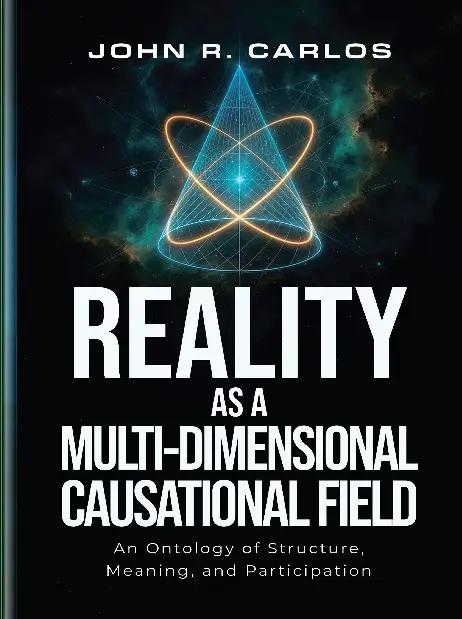
Discover a New Reality and Rediscover Your Soul
The Thesis:
Across intellectual history, the soul has often been treated as a metaphysical principle of life and agency, a topic central to classical philosophy and subsequently to theological traditions. In this monograph, however, the soul is framed not doctrinally but ontologically as a quantum informational substrate that sustains coherence, identity, and agency over time. With this view, consciousness is the active expression of that substrate, its participatory interface with the world, through which potentiality is collapsed into meaningful actuality. This interiority is not sealed within the psyche: the soul remains continuously coupled to the reality interface, integrating experience across repeated participatory crossings rather than containing identity as a closed system.
Two: Foundations of Reality
2.1 Introduction
Any attempt to understand reality must confront the intertwined legacies of philosophy and science. Classical physics once offered a universe governed by strict determinism, a cosmos whose future could be predicted with absolute precision given sufficient information. The advent of quantum mechanics destabilised that vision, introducing uncertainty, probability, and the unsettling implication that observation may play a constitutive role in physical events. Meanwhile, cosmology situates existence within a dynamic, expanding universe shaped by entropy and deep temporal asymmetries.
This chapter surveys these foundational perspectives—classical, quantum, thermodynamic, and cosmological—not as isolated theories, but as complementary and sometimes competing attempts to describe what reality is. Their insights and limitations form the conceptual bedrock upon which the multi‑dimensional causational model proposed in this book is built.
2.2 Classical Perspective: Reality as Objective Structure
For centuries, the prevailing scientific worldview treated reality as an objective, external structure governed by immutable laws. Newtonian mechanics famously captured this perspective, depicting the universe as a vast, clockwork system in which every event is the fully determined consequence of prior conditions.[1] This framework reinforced scientific realism, the view that physical entities exist independently of observation and that the task of science is to reveal the underlying structure of this objective world.[2]
Under this classical paradigm:
- Matter and energy form the fundamental constituents of reality.
- Space and time provide absolute, unchanging frameworks.
- Causation operates linearly, predictably, and without ambiguity.
This vision offered extraordinary explanatory and predictive power. Yet it left little conceptual space for phenomena that resist reduction to mechanical processes—subjective experience, agency, and the participatory role of observation. Classical physics described a world that could, in principle, unfold without witnesses.
2.3 The Quantum Revolution: Indeterminacy and Participation
The emergence of quantum mechanics in the early 20th century radically challenged classical assumptions. At microscopic scales, reality no longer appears deterministic. Instead, it exhibits:
- Wave‑particle duality
- Superposition
- Entanglement
These features reveal a world structured not by certainty but by probability.[3] The notorious observer effect—in which measurement alters the state of a system—suggests that observation is not merely passive but may actively shape the outcome of physical processes.[4]
Physicist John Wheeler captured the philosophical magnitude of this shift in his notion of a “participatory universe”, proposing that reality unfolds through acts of observation.[5] This idea challenges the traditional separation between observer and observed, raising profound questions:
- Is reality a fixed structure or a dynamic interplay between potentiality and observation?
- Does consciousness play a causal role in the collapse of quantum states?
- Is the universe fundamentally informational, relational, or interactive in nature?
Quantum theory therefore marks a turning point: it introduces participation as a potential ontological feature, not merely a methodological inconvenience.
2.4 Entropy and Temporality
While quantum mechanics reshapes our understanding of microphysical processes, thermodynamics reframes our relationship with time. The second law of thermodynamics states that entropy—the measure of disorder—tends to increase in closed systems.[6] This principle establishes the arrow of time, making temporality directional, irreversible, and inescapable.
Entropy governs not only physical processes but also imposes a causational horizon on all phenomena:
- Low‑entropy origin: The universe began in a state of extraordinary order.[7]
- Heat‑death scenario: It may end in thermodynamic equilibrium, devoid of usable energy.[8]
These constraints extend to quantum and cosmological scales. Entropy is not merely a physical principle; it is a structural feature of reality that shapes the emergence, progression, and eventual dissolution of complex systems.[9] In this sense, temporality is not passive backdrop but active determinant.
2.5 Cosmological Context
Modern cosmology deepens this picture by situating reality within an expanding universe driven by dark energy, gravitational curvature, and quantum fluctuations.[10] The origin of the universe’s extraordinarily low‑entropy initial state remains a major scientific puzzle, prompting competing hypotheses such as:
- Cyclic cosmology, in which the universe undergoes repeated cycles of birth and collapse.[11]
- Multiverse theories, which posit a vast ensemble of universes with varying physical laws.[12]
These proposals expand the conceptual scope of “reality,” challenging the assumption that our observable cosmos is the totality of existence. They also underscore the limits of reductionist models, suggesting that current scientific paradigms may describe only a local manifestation of deeper structures.
2.6 Limitations of Current Paradigms
Despite their immense explanatory power, contemporary scientific models face persistent limitations:
- They cannot fully account for subjective experience or conscious agency.
- They struggle to explain the participatory features implied by quantum measurement.
- They offer no definitive account of the origin of low entropy or the future of consciousness in a thermodynamic universe.
These gaps signal the need for a broader ontology—one that integrates the physical, metaphysical, temporal, and quantum dimensions of existence with the experiential and participatory aspects of being.
The multi‑dimensional causational model developed in the following chapters aims to provide such an integrative framework, reconciling structural explanations with the vital roles of meaning, observation, and consciousness.
[1] Newton, I. Philosophiæ Naturalis Principia Mathematica. 1687
[2] Psillos, S. Scientific Realism: How Science Tracks Truth. Routledge, 1999
[3] Heisenberg, W. Physics and Philosophy: The Revolution in Modern Science. Harper, 1958
[4] Bohr, N. “Discussion with Einstein on Epistemological Problems in Atomic Physics.” In Albert Einstein: Philosopher-Scientist, 1949
[5] Wheeler, J. A. “Law Without Law.” In Quantum Theory and Measurement, Princeton University Press, 1983
[6] Clausius, R. “On the Mechanical Theory of Heat.” Annalen der Physik, 1850
[7] Carroll, S. From Eternity to Here: The Quest for the Ultimate Theory of Time. Dutton, 2010
[8] Davies, P. The Last Three Minutes. Basic Books, 1994
[9] Penrose, R. The Road to Reality. Vintage, 2005
[10] Hawking, S. A Brief History of Time. Bantam Books, 1988
[11] Steinhardt, P., & Turok, N. “A Cyclic Model of the Universe.” Science, 2002
[12] Tegmark, M. Our Mathematical Universe. Knopf, 2014
Sneak - Peek
Scroll through this sneak peek preview to see if Cryonic Dreams hooks you like it has so many other readers. At the end, you can unlock the entire Third chapter for FREE by signing up to the newsletter!
Join The Community!
Sign-up to the newsletter to receive exclusive content and news from John R Carlos

- The Thesis
The Thesis
The Central Question
Few questions have endured across the history of human thought as persistently as the inquiry, What is reality? From Plato’s ideal forms to the probabilistic frameworks of modern quantum mechanics, thinkers have wrestled with whether reality is a mind‑independent structure or a phenomenon inseparable from consciousness. The long arc of philosophical and scientific reflection reveals a tension between two intuitions: that reality exists “out there,” independent of us, and that reality is somehow shaped, mediated, or even brought forth through perception and participation.

